
- How a Portable Power Station Works
- Key Advantages and Limitations
- How an Inverter Generator Works
- Key Advantages and Limitations
- Choose a Portable Power Station If …
- Choose an Inverter Generator If …
- Portable Power Station Usage Scenarios
- Inverter Generator Usage Scenarios
Introduction
Power outages can happen at any time – during a storm, a grid fault, or planned maintenance. When they do, they can be inconvenient. Maybe you work from home and need to keep your router and laptop running. Maybe you want a quiet, clean power source for camping or your backyard office. Two popular options are portable power stations and inverter generators. Both can keep your essential devices running, but they work very differently. This guide compares them side by side – so you can decide which portable power station for home backup fits your lifestyle, or whether an inverter generator might be a better fit.
What Is a Portable Power Station?
Think of a portable power station as a big, clever battery in a box. You charge it up from a wall outlet (or from solar panels), and then you can plug your devices into it – just like you would at home. It has AC sockets (the standard three-prong outlets), USB ports for phones and tablets, and often a car socket too.
There is no engine inside. No gasoline, no fumes. Most modern power stations use a type of battery called LiFePO₄ (lithium iron phosphate). They are very safe, last for thousands of charges, and don’t degrade quickly.
Advantages:
- Very quiet operation – around 30dB (quieter than a library, roughly the sound of rustling leaves). A small fan runs when the unit is under load, but it is barely noticeable indoors.
- Zero emissions – safe to use indoors, in a tent, or in an RV.
- No fuel costs – just recharge from the grid or solar.
- Almost no maintenance – keep it charged and store it dry.
- Can be recharged by solar panels for clean, renewable energy.
Limitations:
- Higher upfront cost than a basic generator.
- Runtime is limited by battery capacity – once empty, you need to recharge (grid or solar).
- Recharging takes time (though many modern units, like the FOSSiBOT F2400, can recharge in 1.5 hours).

What Is an Inverter Generator?
An inverter generator is a more modern version of a gasoline generator. Like a traditional generator, it burns fuel (gasoline or propane) to spin an engine and create electricity. But there is a big difference:
- A traditional generator produces “rough” electricity that can damage sensitive electronics like laptops and TVs. It also runs at full speed all the time – loud and thirsty.
- An inverter generator adds smart electronics. It cleans up the electricity into a stable, smooth form (called “pure sine wave”) that is safe for any device. It also speeds up or slows down the engine depending on how much power you need, so it is quieter and uses less fuel.
In short: an inverter generator is still a gas machine – it makes noise, needs fuel, and produces exhaust fumes. But it is much nicer to live with than the old, rattly traditional generators.
Advantages:
- Much cleaner power than traditional generators – safe for laptops, TVs, and other sensitive electronics.
- Quieter and more fuel‑efficient than traditional generators (thanks to variable engine speed).
- Lower upfront cost than a portable power station of comparable power output.
- Can run continuously as long as you have fuel – good for multi‑day off‑grid use.
Limitations:
- Still produces carbon monoxide – must always be used outdoors, away from windows and doors.
- Makes constant noise (50–65dB – about the volume of a normal conversation).
- Requires ongoing fuel purchases (gasoline or propane).
- Needs regular engine maintenance (oil changes, spark plugs, air filter cleaning).
- Light gasoline smell – cannot be stored indoors without precautions.
Portable Power Station vs Inverter Generator: Key Differences
| Feature | Portable Power Station | Inverter Generator |
|---|---|---|
| Noise Level | Very quiet – around 30dB (fan noise, similar to a quiet library). Barely noticeable indoors, even at night. | 50–65dB – clearly audible, like a normal conversation. Noticeable at night or in quiet neighborhoods. |
| Emissions & Safety | Zero emissions. Safe indoors, garage, tent, RV. | Produces carbon monoxide. Outdoor use only. |
| Total Cost of Ownership | Higher upfront, zero fuel cost, minimal maintenance. | Lower upfront, but regular fuel and maintenance costs add up. |
| Runtime | Limited by battery capacity. Recharge needed after hours/days. | Continuous as long as fuel lasts. |
| Portability & Storage | No fuel, no oil, no smell. Store anywhere. | Drain fuel or add stabilizer. Slight gasoline smell. |
| Environmental Impact | Zero direct emissions. Can run on solar. | Burns fossil fuel, emits CO₂ and pollutants. |
Which One Should You Choose? – A Quick Guide
- You need an indoor‑safe backup for power outages (working from home, keeping the router and fridge running).
- You want very quiet, fume‑free operation – no smell, minimal noise.
- You live in an apartment, townhouse, RV, or have a backyard office.
- You prefer zero ongoing fuel costs and almost no maintenance.
- You want the option to recharge with solar panels for clean energy – making it a true portable power station for home backup that you can rely on.
- You need continuous high‑power output for three days or more off‑grid, with no access to grid or solar recharging.
- You are in a remote rural area where buying gas is easy and you have outdoor space to run the generator safely.
- You have a lower upfront budget and are comfortable with regular fuel and engine maintenance.
Real-World Applications
- Home backup during power outages: Run a fridge, a few lights, a router, and charge phones and laptops for 6–12 hours.
- Backyard office / shed: Power a monitor, laptop, and desk lamp without running an extension cable from the house.
- Camping and RV trips: Very quiet, fume‑free power for lights, coolers, and charging devices – even inside the tent or RV. Many outdoor enthusiasts consider this the best portable power station for home backup that also works perfectly on the road.
- Outdoor events and markets: Clean, quiet power for speakers, coffee machines, or a small cash register.
- Remote building site or cabin: Run power tools, heaters, or a water pump for days with easy refueling.
- Long‑term off‑grid living: If you have no reliable sun for solar and no grid access, fuel may be the only option.
- Emergency backup for whole‑home heating: Some high‑wattage heating systems need continuous, high load for days – a large inverter generator can handle that.

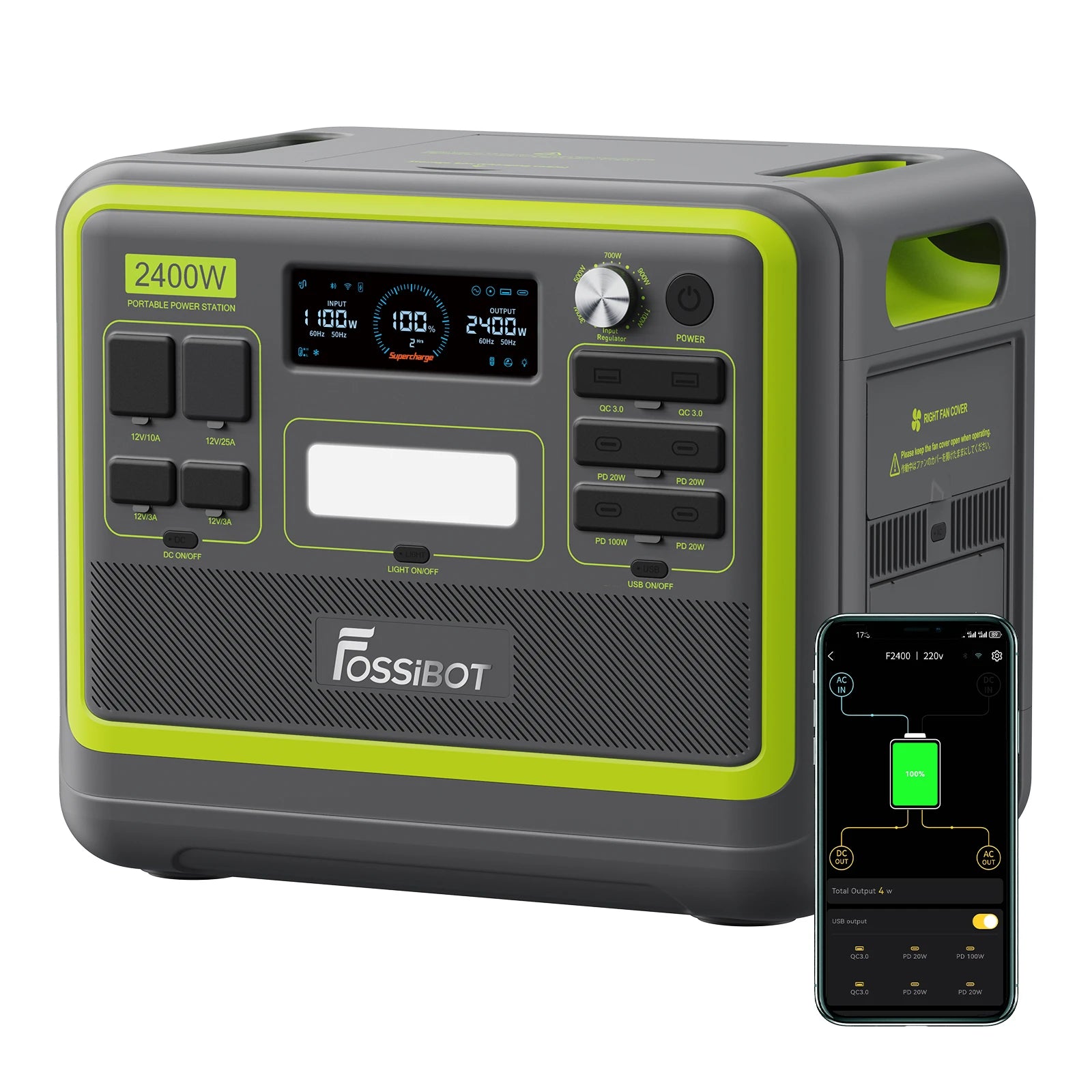
FOSSiBOT F2400 – A Portable Power Station Built for US Homes
If you are leaning towards a portable power station, the FOSSiBOT F2400 is worth a closer look. It is a mid‑to‑large capacity model that fits most home backup and outdoor needs.
Key specifications
- Capacity: 2048Wh (enough to run essential home devices through a 12‑hour power outage)
- Output: 2400W continuous, 4800W peak – can handle a fridge, microwave, coffee maker, TV, router, lights and even power tools simultaneously.
- Battery type: Premium EVE® LiFePO₄ battery with 4000+ charge cycles to 80% capacity – that’s more than 10 years of daily use.
- Fast charging: 0–100% in just 1.5 hours via AC wall outlet, or via solar (up to 500W input).
- Output ports: 16 versatile ports including standard AC outlets, USB‑A, USB‑C (100W PD for laptops), and a 12V car port.
- Smart features: HD LCD display, LED lighting with SOS mode, Bluetooth & WiFi app control for real-time monitoring.
- UPS mode: <8ms switchover – connect it between the wall and your computer for uninterrupted power during an outage.
- Warranty: 5‑year hassle-free warranty.
Conclusion: Which Is Right for You?
Neither portable power stations nor inverter generators are universally “better”. The right choice depends entirely on your situation. For most US households – especially those in towns, suburbs or cities – a portable power station US model like the FOSSiBOT F2400 is more practical: it is very quiet, safe indoors, clean and cheap to run. For remote, long‑duration, high‑load off-grid scenarios where you cannot recharge a battery, an inverter generator may still be the right tool. Use this portable power station vs inverter generator comparison to match your priorities, and you will end up with the backup power solution that works best for you.
Frequently Asked Questions (FAQ)
1. Can a portable power station run a fridge or TV during a power outage?
Yes. The FOSSiBOT F2400’s 2400W output can run a standard fridge (100‑300W) for 10‑12 hours, and a modern LED TV (50‑100W) for 20‑40 hours.
2. Are inverter generators allowed inside a house or garage?
No. They produce carbon monoxide, which is odorless and deadly in enclosed spaces. Always use an inverter generator outdoors, well away from windows, doors and vents.
3. How long does a portable power station last on a single charge?
It depends on the load. A 2048Wh unit like the F2400 powering a laptop (65W) could last over 30 hours. Powering a fridge and lights for a few hours is no problem.
4. Can I recharge a portable power station with solar panels in the US?
Yes. The F2400 supports up to 500W of solar input. Even on cloudy days, solar panels can contribute, and on sunny days they can fully recharge the unit in a few hours.
5. What is the best portable power station for home backup?
Many good options exist, but the FOSSiBOT F2400 offers a strong balance of capacity (2048Wh), output (2400W pure sine wave), fast 1.5‑hour charging, LiFePO₄ battery life, and a 5‑year warranty – making it a solid choice for US households.


