
Table of Contents
- Introduction
- What Is a Portable Pellet Grill?
- How to Power a Pellet Grill While Camping?
- How Much Power Does a Pellet Grill Actually Use?
- What Size Power Station Do You Need?
- How Long Will a Power Station Run a Pellet Grill?
- Building the Ultimate Off-Grid Camping Setup
- Can You Solar Charge While Camping?
- Portable Power Station vs. Gas Generator (Final Verdict)
- Pro Tips for Using a Pellet Grill with a Power Station
- FAQ
- Conclusion
Introduction
A portable pellet grill transforms your outdoor cooking experience, letting you enjoy smoked brisket or grilled steaks without babysitting charcoal. But here’s the catch that trips up most first-timers: even a pellet grill needs electricity.
While wood pellets generate the heat, the auger, fan, controller, and electronic igniter all rely on a steady power supply. If you’re camping at a site without an electrical hookup, a traditional generator works—but it’s loud, fume-heavy, and overkill for a small grill.
That’s where a portable power station comes in. It delivers clean, silent AC power with zero exhaust. In this guide, we’ll cover exactly how to run your pellet grill off-grid, how to calculate battery runtime, and which FOSSiBOT power station fits your camping style.

What Is a Portable Pellet Grill?
A portable pellet grill is a compact, pellet-fueled smoker/grill designed for travel. It's a top choice for camping, RV trips, tailgating, fishing, and hunting.
Unlike traditional charcoal grills that require constant air and coal management, a pellet grill uses an automated system. It steadily feeds wood pellets into a firepot while regulating airflow to lock in your desired temperature.
Why Does It Need Electricity?
It’s easy to assume “wood pellets = fire = no electricity,” but these four components say otherwise:
· Auger: Drives pellets from the hopper into the firepot.
· Fan: Manages oxygen flow for proper combustion.
· Controller: Maintains the set temperature and runs the digital display.
· Igniter: Glows hot to ignite the pellets during startup.
This is why a pellet grill isn’t truly “off-grid” on its own. You can take the grill anywhere, but you must bring the juice.
How to Power a Pellet Grill While Camping?
If your site lacks shore power, you have two practical routes: a gas generator or a portable power station.
Gas Generator (The Old Way)
A gas generator can certainly deliver plenty of AC watts. However, it introduces problems you don’t want at a serene campsite:
· Requires carrying and storing gasoline (fire hazard + smell).
· Produces toxic carbon monoxide (must be placed far from the tent).
· Generates irritating noise for you and neighboring campers.
Portable Power Station (The Smart Way)
A portable power station is essentially a large, rechargeable battery with an AC inverter built-in. For camping, this translates to:
· Whisper-quiet operation.
· No gasoline or oil needed.
· Zero fumes (safe to keep nearby).
· Lightweight & portable.
· Multiple outputs (AC, USB-C, DC) for all your gadgets.
· Solar recharging support on compatible models.
For a pellet grill specifically, a power station is ideal because you only need stored energy for intermittent loads rather than continuously burning fuel.
How Much Power Does a Pellet Grill Actually Use?
Before buying a power station, flip your grill over and check its electrical rating. Look for wattage (W) and start-up surge.
Understanding Watts vs. Watt-Hours
These two metrics confuse many campers. Here’s the plain-English breakdown:
· Watts (W): The "speed" of power your grill demands at any given moment.
· Watt-hours (Wh): The "gas tank" size of your power station.
W = Power needed NOW
Wh = Energy stored for LATER
A larger Wh rating simply means you can run the grill for more hours (assuming the same draw).
Real-World Grill Power Examples
To make this concrete, here’s what popular portable pellet grills typically draw:
|
Grill Model (Estimate) |
Normal Running Wattage |
Startup (Surge) Wattage |
|
Traeger Ranger / Scout |
100W – 150W |
~200W – 250W |
|
Pit Boss Tabletop |
120W – 180W |
~300W |
|
Larger Portable Units |
150W – 200W |
~400W+ |
Pro Tip: Always check the startup wattage! The igniter draws significantly more power for the first 3–5 minutes. If your power station’s AC output can’t handle the surge, it will shut off immediately.
What Size Power Station Do You Need?
The "right" size isn’t just about the grill. Ask yourself:
1. How long will I smoke/cook? (2 hours or 10 hours?)
2. What else am I powering? (Just the grill, or also a mini-fridge, lights, and phones?)
1,024Wh – The Compact Camping Choice (FOSSiBOT F1800)
If portability is your priority and you just need to run the grill for a few hours, the FOSSiBOT F1800 (1,024Wh) is a perfect match.
Let’s do the math with a typical 100W average draw:
1,024Wh ÷ 100W ≈ 10.2 hours
Note: Real-world runtime is slightly lower due to inverter inefficiency (~85-90%) and the fan cycling on/off. You’re realistically looking at 8–9 hours of cooking time.
Why FOSSiBOT F1800 stands out here:
· It features a LiFePO₄ (Lithium Iron Phosphate) battery, offering 3,500+ life cycles—far longer than standard lithium-ion.
· The Pure Sine Wave Inverter protects your grill’s sensitive controller from voltage spikes.
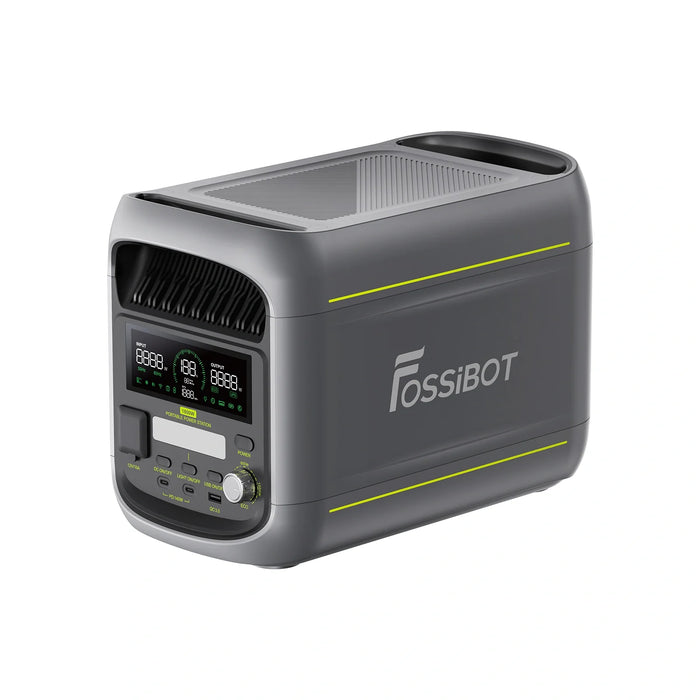
2,048Wh – Extended Capacity for Weekenders (FOSSiBOT F2400)
For longer camping trips or if you’re also keeping a 12V fridge running overnight, the FOSSiBOT F2400 (2,048Wh) is the smarter investment. It provides double the stored energy.
With this setup, you can easily run:
· Pellet grill (6–8 hours of smoking).
· 12V/110V mini-fridge (24+ hours).
· LED camping lights and phone charging simultaneously.
Bottom Line: The best power station isn’t the biggest one; it’s the one that matches your total load and planned runtime. The F1800 nails short trips; the F2400 dominates extended weekends. [Shop FOSSiBOT F1800 here] & [Shop FOSSiBOT F2400 here].
How Long Will a Power Station Run a Pellet Grill?
There’s no one-size-fits-all answer, but you can use this quick formula:
Runtime (hours) ≈ (Battery Wh × Inverter Efficiency) ÷ Average Grill Watts
Assuming 90% efficiency (typical for pure sine wave inverters):
· F1800 (1,024Wh) + 100W Grill ≈ 9.2 hours.
· F2400 (2,048Wh) + 150W Grill ≈ 12.3 hours.
Variables that change the number:
· Cooking temperature (higher heat = more pellet feed = slightly higher power).
· Ambient temperature (cold weather might make the fan run longer).
· Startup cycles (the initial surge consumes extra energy).
Golden Rule: Always reserve 15-20% battery for emergencies (phone calls, CPAP machines, or unexpected weather). Don’t plan to drain it to zero.
Building the Ultimate Off-Grid Camping Setup
The real beauty of a power station is that it becomes the energy hub of your entire campsite, not just a grill battery.
Here’s a dream setup using the FOSSiBOT F2400:
1. Pellet Grill → Plugged into AC port for cooking.
2. Mini Fridge → Keeps drinks cold for 2 days.
3. Solar Panels (Connected to the FOSSiBOT's solar input) → Recharges the station during the day while you’re kayaking or hiking.
4. USB-C Ports → Fast-charges laptops and drones.
Can You Solar Charge While Camping?
Yes. The FOSSiBOT F1800 and F2400 both support high-wattage solar input (up to 400W+). This is a game-changer for multi-day stays.
The setup is simple:
[Solar Panel] → [FOSSiBOT Power Station] → [Pellet Grill & Devices]
Note: Solar charging speed depends on sunlight intensity, panel angle, and weather. However, on a sunny day, you can fully recharge the F1800 in roughly 3–4 hours.

Portable Power Station vs. Gas Generator (Final Verdict)
Here’s the quick side-by-side for campers:
|
Feature |
Portable Power Station (FOSSiBOT) |
Gas Generator |
|
Noise |
Silent (0 dB idle, very quiet fan) |
Extremely noisy (70+ dB) |
|
Fuel / Emissions |
Clean battery, zero fumes |
Gasoline, smells, emits CO |
|
Safety |
Safe to use near tent |
Must keep at distance (CO risk) |
|
Solar Recharge |
Yes (Free energy) |
No |
|
Maintenance |
None |
Oil changes, fuel stabilizer |
|
Portability |
Carry in one hand |
Heavy, awkward to move |
If you need to run a 1,500W power tool, get a generator. But if you want quiet, convenient, and safe power for a pellet grill and weekend gear, a portable power station is the clear winner.
Pro Tips for Using a Pellet Grill with a Power Station
· Pre-charge everything: Always leave home with 100% battery.
· Preheat smartly: Start your grill using the power station. Once the igniter turns off after 3-5 minutes, the load drops significantly, saving battery.
· Keep cables dry: Place the power station on a raised surface (like a log or table) to avoid ground moisture.
· Monitor the app: Use the FOSSiBOT display (or companion app if available) to watch real-time wattage and remaining time.
FAQ
Q: Do portable pellet grills need electricity?
A: Yes. The auger, fan, controller, and igniter all require electricity to function.
Q: Can I use a pellet grill while camping without a hookup?
A: Absolutely. Just pair it with a portable power station like the FOSSiBOT F1800 or F2400 to run it off-grid.
Q: How many watts does a typical pellet grill use?
A: Most small portable grills run between 100W and 200W normally, but can spike to 300W–400W during startup ignition.
Q: Can I run a pellet grill and a mini fridge from the same power station?
A: Potentially, yes. Calculate the combined running wattage. For example, a 100W grill + 60W fridge = 160W total. The F2400 (2,048Wh) could run both for roughly 12 hours. Just ensure the surge power doesn't exceed the station's AC output limit.
Q: Can solar panels power a pellet grill directly?
A: Not directly. Solar panels charge the power station (via DC input), and the power station converts that stored energy to AC power for the grill. This is the safest and most efficient method.
Conclusion
A portable pellet grill delivers incredible barbecue flavor anywhere, but it still needs a reliable electrical source for its core components. When you're away from shore power, a portable power station like the FOSSiBOT F1800 or F2400 offers the quietest, cleanest, and most convenient solution.
Choose the F1800 for light weekend cookouts and maximum portability. Choose the F2400 for extended trips where you need to power refrigeration and multiple devices alongside your grill.
With the right battery setup, you truly don’t have to choose between off-grid adventure and delicious, smoked perfection—you can enjoy both, anywhere.
Ready to take your camping kitchen off-grid? [Explore the full FOSSiBOT power station lineup here →]


