
Table of Contents
- Introduction
- What Is a Watt (W)?
- What Is a Watt‑Hour (Wh)?
- Watts vs. Watt‑Hours
- How Watts Affect What a Power Station Can Run
- How Watt‑Hours Affect Runtime
- What Affects Actual Runtime?
- What About Amps and Volts?
- 1,024Wh vs. 1,800W: Why Are These Numbers Different?
- How to Choose a Power Station Using W and Wh
- W vs. Wh: The Bottom Line
- FAQ
Introduction
When shopping for a portable power station, two numbers appear almost everywhere: watts (W) and watt‑hours (Wh). While they may look similar, they measure two different things.
Watts tell you how much power a device needs or a power station can deliver. Watt‑hours tell you how much energy a battery can store and how long it can power your devices.
Understanding the difference between watts and watt‑hours makes it easier to choose the right portable power station for camping, RV trips, home backup, and power outages.

What Is a Watt (W)?
A watt (W) is a unit of power. It describes how quickly electrical energy is being used or delivered at a given moment.
For example, a device rated at 100W requires more power to operate than one rated at 20W.
Common examples include:
- LED light: around 5–15W
- Laptop: around 40–100W
- TV: around 50–150W
- Refrigerator: often hundreds of watts while running, with higher startup demand
- Microwave: often 1,000W or more
Actual power consumption varies by model, operating mode, and manufacturer specifications, so these figures are only examples.
What Does a Power Station's Watt Rating Mean?
When a portable power station is rated at 1,800W, the 1,800W figure primarily refers to its maximum continuous AC output under specified operating conditions.
This tells you about the size of the electrical load it can support.
For example, if your devices require 1,200W in total, a power station with a 1,800W output rating may be able to handle the load, assuming the devices' startup requirements and the power station's operating limits are compatible.
Some appliances, particularly those with motors or compressors, can draw significantly more power when starting. This is why peak or surge output matters when powering refrigerators, pumps, power tools, and similar equipment.
In simple terms:
Watts help answer: Can the power station run this device?
What Is a Watt‑Hour (Wh)?
A watt‑hour (Wh) is a unit of energy. For batteries and portable power stations, it is commonly used to describe energy storage capacity.
One watt‑hour represents the amount of energy used by a 1W device running for one hour.
For example:
100W × 5 hours = 500Wh
This is why portable power stations are labeled with capacities such as 288Wh, 1,024Wh, or 2,048Wh.
A higher Wh rating generally means the battery stores more energy and can provide longer runtime. However, it does not automatically mean the power station can run higher‑powered appliances.
A power station needs sufficient output wattage to run a device and sufficient Wh capacity to run it for the desired amount of time.
How Do You Calculate Watt‑Hours?
For a basic energy calculation:
Watt‑hours (Wh) = Power (W) × Time (hours)
For example, a 100W device running for 5 hours consumes:
100W × 5h = 500Wh
This formula describes the energy required by the device. When estimating how long a device will run from a portable power station, however, you also need to account for typical energy losses during operation.

Watts vs. Watt‑Hours
The easiest way to remember the difference is:
|
Watts (W) |
Watt‑Hours (Wh) |
|
Measures power |
Measures energy |
|
Describes how much power is needed or delivered |
Describes how much energy is stored |
|
Mainly affects what you can run |
Mainly affects how long you can run it |
|
Example: 1,800W output |
Example: 1,024Wh capacity |
Think of it this way:
W = power demand
Wh = energy available
A portable power station needs enough watts to handle your devices and enough watt‑hours to run them for the amount of time you need.
How Watts Affect What a Power Station Can Run
Before choosing a portable power station, check the power requirements of the devices you want to use.
Check Running Wattage
Look at the device label, user manual, or manufacturer's specifications to find its rated or typical power consumption.
If you plan to run several devices at the same time, add their power requirements together.
For example:
- Laptop: 60W
- Monitor: 40W
- Wi‑Fi router: 15W
- LED light: 10W
Total load: 60W + 40W + 15W + 10W = 125W
The power station's continuous output should be sufficient for the combined load.
Consider Startup Power
Some devices don't consume the same amount of power continuously.
Refrigerators, sump pumps, power tools, and other motor‑driven equipment can require additional power when starting. Their startup demand may be substantially higher than their normal running wattage.
When checking whether a power station can run an appliance, consider:
- Running wattage
- Startup or surge demand
- The power station's continuous output
- The power station's peak output
This is particularly important for home backup applications.
How Watt‑Hours Affect Runtime
How long will it run?
That's where watt‑hours matter.
For a practical portable power station runtime estimate, you can use:
Estimated runtime ≈ Battery capacity (Wh) × 0.85 ÷ Device power (W)
The 0.85 factor provides a simple estimate that accounts for typical energy losses during power conversion and operation.
For example, a 1,024Wh power station powering a 100W device would provide approximately:
1,024Wh × 0.85 ÷ 100W ≈ 8.7 hours
Actual runtime can still vary depending on the connected device, power consumption, operating conditions, and the power station's own energy consumption.
The Same Power Station Can Have Different Runtime
Consider a 1,024Wh power station:
|
Load |
Estimated Runtime |
|
50W |
17.4 hours |
|
100W |
8.7 hours |
|
250W |
3.5 hours |
|
500W |
1.7 hours |
|
1,000W |
0.9 hour |
These figures use the Wh × 0.85 ÷ W estimation method and are intended as practical estimates rather than guaranteed real‑world runtimes.
The key point is simple: the higher the load, the faster the stored energy is consumed.

What Affects Actual Runtime?
The 0.85 factor is a practical estimation method, but actual runtime can still vary.
Several factors can affect how much usable energy you get from a power station:
- Power conversion efficiency: Converting stored battery energy into usable AC power results in some energy loss.
- Standby consumption: The power station itself uses some energy while operating, even when the connected load is relatively small.
- Operating conditions: Temperature, battery condition, and the characteristics of the connected device can affect performance.
- Load characteristics: Devices with motors, compressors, or changing power demands may not consume a constant amount of power.
For this reason, runtime calculations should be treated as estimates rather than guaranteed operating times.
What About Amps and Volts?
Power station specifications may also include amps (A) and volts (V). These describe different electrical properties but are related to watts.
What Is an Amp?
An ampere (A), commonly called an amp, measures electrical current.
In simple terms, it describes the amount of electric current flowing through a circuit.
What Is a Volt?
A volt (V) measures electrical voltage, or the electrical potential that drives current through a circuit.
How Are Watts, Volts, and Amps Related?
For a simple electrical calculation:
Watts (W) = Volts (V) × Amps (A)
For example:
12V × 10A = 120W
This relationship can be useful when looking at specifications for DC outputs, solar inputs, car charging, and other electrical connections.
For everyday portable power station sizing, however, you can start with the two numbers that matter most:
W → Can it power the device?
Wh → How long can it power the device?
1,024Wh vs. 1,800W: Why Are These Numbers Different?
A portable power station can have both a Wh capacity rating and a W output rating, but they describe different capabilities.
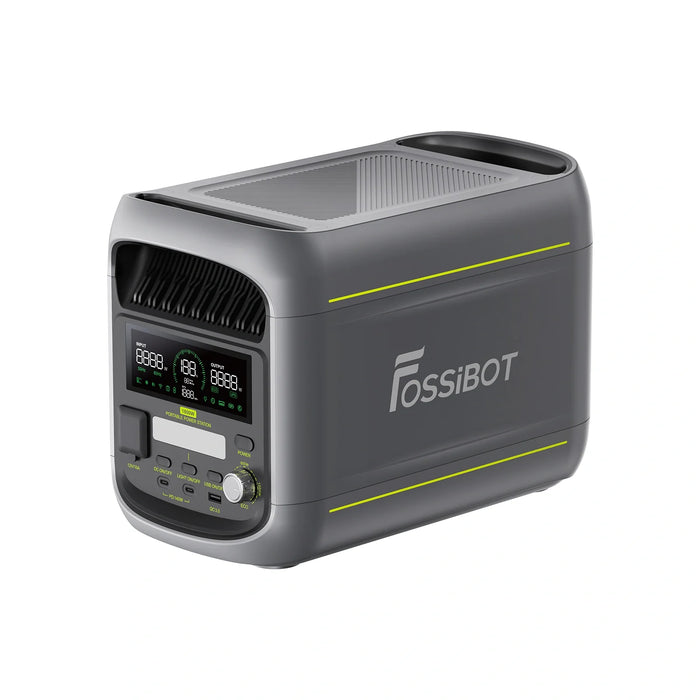
Take the FOSSiBOT F1800 portable power station as an example. It is used here only to illustrate how these specifications work; it is not the only option.
- 1,024Wh battery capacity
- 1,800W rated output
- 3,600W peak output
The 1,024Wh figure describes how much energy the battery can store.
The 1,800W figure describes how much continuous power the station can deliver within its specified operating limits.
The 3,600W peak rating describes its ability to handle higher short‑term power demands within applicable conditions.
These numbers should not be compared directly because they measure different things.
For example, using the same 0.85 estimation factor:
At a continuous 100W load:
1,024Wh × 0.85 ÷ 100W ≈ 8.7 hours
At a continuous 500W load:
1,024Wh × 0.85 ÷ 500W ≈ 1.7 hours
The battery capacity hasn't changed. The difference comes from how quickly the connected devices consume the stored energy.
How to Choose a Power Station Using W and Wh
Choosing the right power station comes down to three basic steps.
1. List What You Need to Power
Think about the devices you actually need during a camping trip, RV trip, or power outage.
For camping, that might include:
- Phones
- Laptops
- Lights
- Portable refrigerators
- Fans
- Cameras
For home backup, you might prioritize:
- Refrigerator
- Wi‑Fi router
- Lights
- TV
- CPAP machine
- Sump pump
- Essential electronics
2. Check Their Wattage
Find the rated or typical power consumption of each device.
If you want to run multiple devices simultaneously, estimate the combined load.
Then make sure the power station's continuous output is sufficient, while also considering startup requirements for appliances with motors or compressors.
3. Estimate How Many Watt‑Hours You Need
Estimate how long you want each device to operate.
For the device's energy requirement:
Device wattage × operating hours = energy required (Wh)
When estimating the power station capacity you need, allow for energy losses rather than choosing a capacity based on the exact theoretical minimum.
For example, if a device uses 100W for 8 hours:
100W × 8h = 800Wh
A practical estimate should then account for the 0.85 efficiency factor, meaning you would need approximately:
800Wh ÷ 0.85 ≈ 941Wh
This gives you a more realistic starting point when comparing power station capacities.
W vs. Wh: The Bottom Line
Watts (W) tell you whether a power station can run a device. Watt‑hours (Wh) tell you how much energy is available to keep it running.
When choosing a portable power station, make sure it has enough output power for your devices and enough battery capacity for the runtime you need.
Once you understand the difference, specifications such as 1,024Wh, 1,800W, and 2,048Wh become much easier to interpret.
FAQ
What does watt‑hour (Wh) mean?
A watt‑hour is a unit of energy used to describe how much energy a battery can store or how much energy a device consumes over a period of time.
What is the difference between watts and watt‑hours?
Watts measure power, while watt‑hours measure energy. Watts help determine whether a power station can run a device, while watt‑hours help estimate how long it can run.
Is Wh the same as W?
No. W measures power, while Wh measures energy. A device that uses 100W for 5 hours consumes 500Wh.
Is a higher watt‑hour rating better?
A higher Wh rating means greater energy storage capacity and can generally provide longer runtime. However, you also need sufficient output wattage to make sure the power station can handle your devices.
Does higher Wh mean more power?
No. Wh measures stored energy, while W measures power. A power station can have a large Wh capacity but a lower output wattage, so both specifications should be considered.
How do you calculate watt‑hours?
For a basic energy calculation, multiply power in watts by operating time in hours:
Wh = W × hours
For example, a 100W device running for 5 hours consumes 500Wh.
How many watt‑hours do I need for a power station?
It depends on what you want to power, how much power those devices use, and how long you need them to run.
First calculate the energy required:
Device wattage × operating hours = required Wh
Then account for typical energy losses and compare the result with the power station's capacity.
How many Wh do I need to run a fridge?
It depends on the refrigerator's running wattage, duty cycle, ambient temperature, and startup demand. Because a refrigerator's compressor cycles on and off, its average power consumption can be lower than its rated running wattage.
For a more accurate estimate, use the refrigerator's actual or estimated average power consumption and allow for energy losses and startup requirements.
Can a 1,000W power station run a microwave?
It depends on the microwave's power requirements. Many microwaves draw 1,000–1,500W or more, so a 1,000W power station may not be able to support a higher‑wattage model.
Check the microwave's rated power and compare it with the power station's continuous and peak output ratings.
How long will a 500Wh power station last?
Using the 0.85 runtime estimation:
Estimated runtime ≈ 500Wh × 0.85 ÷ Device power (W)
For example:
- 50W load: about 8.5 hours
- 100W load: about 4.3 hours
- 250W load: about 1.7 hours
- 500W load: about 0.9 hour
Actual runtime may vary depending on the device and operating conditions.
How long will a 1,000Wh power station last?
It depends on the load. Using the 0.85 estimation:
- 100W load: about 8.5 hours
- 500W load: about 1.7 hours
- 1,000W load: about 0.9 hour
Higher‑wattage devices consume stored energy faster, while lower‑power devices can run for longer.
What is surge wattage?
Surge wattage, also called peak or startup wattage, is the short‑term power a device may need when starting. Motors and compressors in refrigerators, pumps, and power tools can require significantly more power at startup than during normal operation.
A power station's peak output rating indicates how much short‑term power it can handle under its specified operating conditions.


